






In retail planning, competitive advantage doesn't come from having machine learning. It comes from the ability to act on it.
There's a persistent anxiety in retail planning circles that AI will commoditize the profession. If everyone has access to the same sophisticated forecasting models, the same pattern recognition algorithms, the same predictive capabilities, what differentiation remains?
This concern rests on a fundamental misunderstanding about where competitive advantage actually comes from in AI-enabled planning. And it's a misunderstanding that could cause planning organizations to miss the real strategic opportunity in front of them.
The Open Source Reality
Here's an uncomfortable fact for planning organizations investing heavily in proprietary AI capabilities: many of the most powerful forecasting models are already freely available.
XGBoost, one of the most effective algorithms for retail demand forecasting, is open source. Anyone can download it. Prophet, the time series forecasting tool created by Meta that naturally understands seasonality and holiday effects, is also open source. The underlying mathematics that power sophisticated planning AI aren't secret; they're published in academic papers and implemented in freely available libraries.
So why doesn't every retailer simply download these models and achieve parity in forecasting capability?
Because having the model is the easy part. Making it useful is where the real work begins.
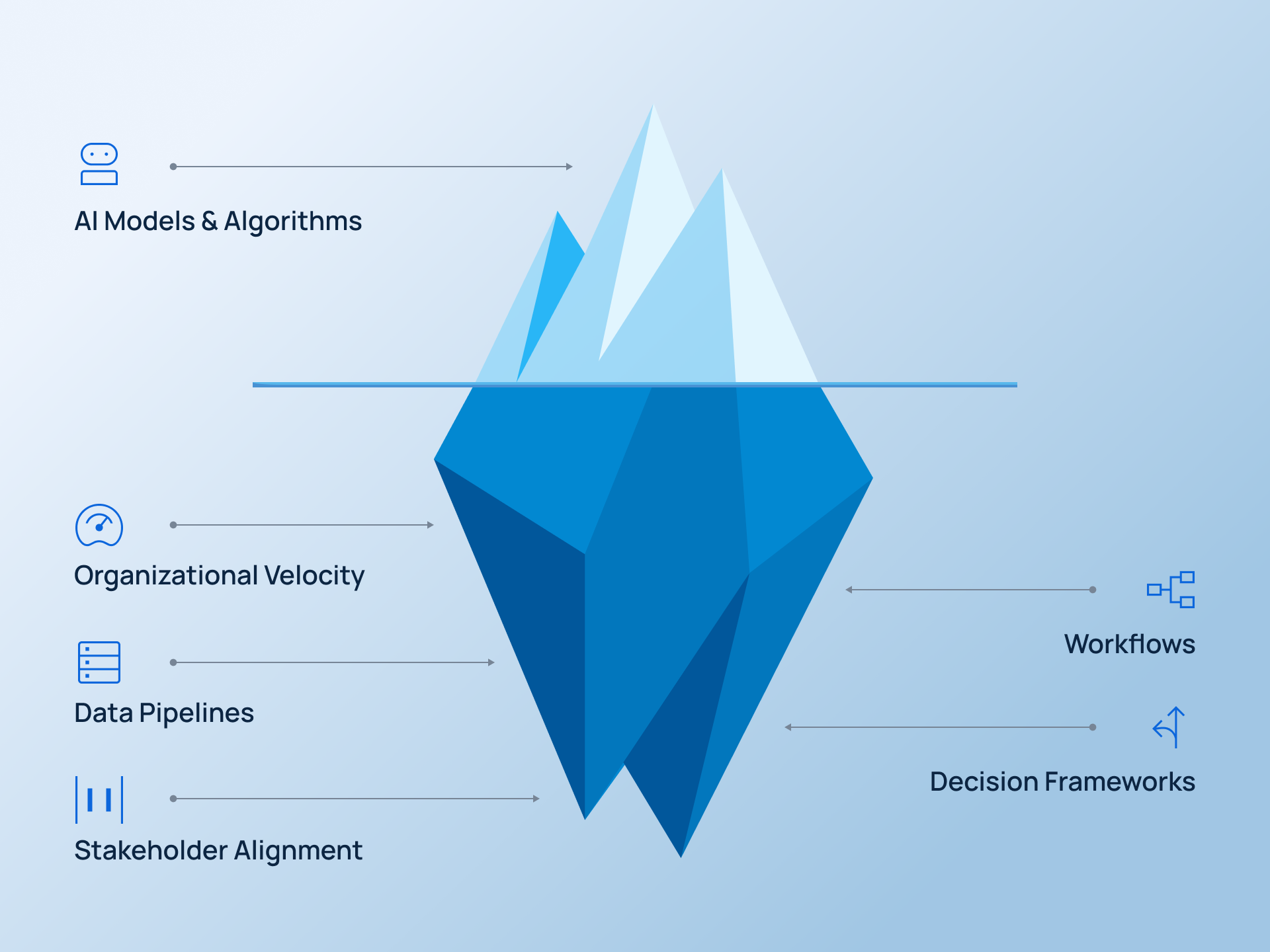
The Implementation Iceberg
When you download an open source forecasting model, you get the algorithm. What you don't get is everything required to make that algorithm valuable in a production planning environment.
You don't get the data engineering infrastructure to feed the model clean, structured data across thousands of SKUs, dozens of stores, and multiple channels. You don't get the monitoring systems to detect when model performance degrades. You don't get the retraining pipelines to update models as patterns shift. You don't get the governance frameworks to ensure forecasts remain explainable and auditable.
You don't get the seasonality adjustments calibrated to your specific business rhythm. You don't get the anomaly detection systems that flag when forecasts look suspicious. You don't get the MAPE tracking across different product hierarchies, time horizons, and store clusters. You don't get the integration with allocation, replenishment, and financial planning workflows.
Most critically, you don't get the organizational capability to actually use the forecasts. The training programs that teach planners how to interpret model outputs. The decision frameworks that clarify when to trust the algorithm versus override it. The feedback loops that improve model performance over time. The stakeholder management processes that build confidence in AI-generated forecasts.
The model might be free. Everything wrapped around it, the infrastructure, the processes, the organizational capability, represents thousands of hours of specialized work. Most retailers struggle not because they can't access the algorithms, but because they can't build and maintain the systems that make those algorithms valuable.
The Workflow Moat
If the models are commoditized, where does competitive advantage actually come from?
The answer is increasingly clear: it comes from the speed at which you can move from signal to insight to action.
Consider two retailers with identical forecasting accuracy. Retailer A identifies a demand shift three weeks out with 85 percent confidence. Their planning team spends a week validating the forecast, another week building scenarios, three days socializing recommendations with merchants, and two days updating buy plans. By the time they act, they're inside their supplier lead time. The forecast was accurate; they just couldn't move fast enough to capitalize on it.
Retailer B sees the same signal with the same confidence. Their planning system automatically explores scenarios, flags the most promising responses, and prepares draft buy adjustments. Within 48 hours, merchants have reviewed options and approved actions. They're already communicating with suppliers while Retailer A is still validating the forecast.
Same model. Same data. Same forecast accuracy. Completely different business outcomes.
The competitive advantage isn't better predictions. It's faster translation of predictions into decisions and decisions into actions. It's organizational velocity enabled by workflows that minimize friction between insight and execution.
This creates a different kind of moat. Competitors can copy your models—they're often freely available. They can copy your data strategy. They can even hire away your data scientists. But they can't easily copy the workflows, the organizational muscle memory, the decision frameworks, and the stakeholder alignment that enable rapid action.
The Proprietary Asset Isn't the Model
This reframes the build-versus-buy decision that many planning organizations face with AI capabilities.
The instinct is often to build proprietary models, reasoning that custom algorithms trained on your specific data will deliver competitive advantage. But if the models are increasingly commoditized and the real value comes from operational execution, building custom algorithms may be optimizing for the wrong thing.
The proprietary asset worth building isn't a better forecasting model. It's the organizational capability to act on forecasts faster than your competitors can. It's the workflows that collapse the time from signal to decision. It's the trust between planning and merchants that enables rapid approval of AI-generated recommendations. It's the supplier relationships that allow you to actually execute on the actions your models suggest.
This suggests a different investment strategy. Rather than concentrating resources on building marginally better algorithms, invest in the infrastructure that enables faster action: better integration between planning and execution systems, cleaner data pipelines that reduce validation overhead, decision frameworks that clarify when to act versus wait, training programs that build planner confidence in model outputs.
The Strategic Implication
If competitive advantage comes from organizational velocity rather than algorithmic sophistication, planning teams need to optimize for different metrics than they historically have.
Traditional planning metrics emphasize accuracy: MAPE, forecast bias, promotion lift prediction error. These remain important, you can't act effectively on forecasts you don't trust. But they may be necessary rather than sufficient for competitive advantage.
The differentiating metrics may be temporal: How quickly do we identify significant deviations from plan? How long does it take to move from forecast to decision? What's our average time from decision to supplier communication? How often do we act on signals while we still have time to influence outcomes?
Organizations that optimize purely for forecast accuracy may find themselves with excellent predictions they can't act on quickly enough to matter. Organizations that optimize for speed of action while maintaining acceptable accuracy may capture disproportionate value from the same underlying models.
The AI Commoditization Paradox
Here's the paradox: as AI capabilities become more accessible and powerful, the opportunity for competitive differentiation may actually increase rather than decrease.
When forecasting was primarily manual, the performance ceiling was relatively low and the performance floor was also low. Some retailers had significantly better planning than others, but the variance was constrained by the limitations of manual processes.
As AI raises the performance ceiling, enabling faster, more accurate, more nuanced forecasting, it also widens the potential gap between organizations that can translate those capabilities into business value and those that can't. The same tools that enable mediocre planners to achieve baseline competence enable exceptional planning organizations to operate at a level that was previously impossible.
This creates a trap for organizations focused on AI parity. The goal isn't matching your competitors' AI capabilities. By the time you achieve parity in models, the leading organizations have moved on to competing on execution velocity, organizational alignment, and decision-making speed, capabilities that can't be purchased or quickly replicated.
The Learning Advantage Compounds
There's another dimension of competitive advantage worth noting: the compounding returns to organizational learning.
When a planning team starts using AI planning tools effectively, they don't just get better forecasts. They develop institutional knowledge about when to trust model outputs, which patterns to investigate, how to override effectively, and where human judgment adds the most value.
This knowledge compounds over time. The team that's been using AI-assisted planning for two years has learned patterns that aren't captured in any playbook. They've developed intuition about their specific models' strengths and weaknesses. They've built relationships with merchants based on delivering value repeatedly. They've optimized workflows through iteration.
A competitor implementing the same models two years later gets the algorithm. They don't get the two years of organizational learning. They'll make mistakes the early adopter already worked through. They'll spend time on questions the early adopter already answered. They'll encounter friction the early adopter already smoothed out.
This creates a temporal moat. Early adopters aren't just ahead; they're learning faster because they've been in production longer. The gap widens even as the underlying technology becomes more accessible.
The Real Question
For planning organizations, the strategic question isn't whether to build or buy AI capabilities. It's whether you can build the organizational infrastructure to act on those capabilities faster than your competitors.
Can you create workflows that minimize the time from insight to decision? Can you build trust between planning and merchants that enables rapid action on model recommendations? Can you develop supplier relationships that allow you to actually execute on the opportunities your forecasts identify? Can you train your team to work effectively alongside AI rather than fighting it?
The retailers that answer yes to these questions will find that AI doesn't commoditize planning—it amplifies the advantage of planning organizations that have built the capability to act.
The retailers that focus primarily on acquiring better models while leaving workflows, decision frameworks, and organizational capabilities unchanged may discover they've invested in technology that makes their competitors faster while leaving them only marginally improved.
Your competitors can download the same models. They can hire similar data scientists. They can access the same training data. What they can't easily replicate is an organization that's learned to move from forecast to action in 48 hours instead of two weeks.
That's the moat worth building. And unlike algorithms, it only gets stronger the longer you work on it.
Much of these concepts are explored more deeply in a recent webinar titled “The Practical Guide to AI in Retail Planning”. Access the on-demand webinar now!


