









Most wholesale planning stops at the loading dock. You know what you shipped. You might know what you invoiced. But what happens after your product reaches the retailer? For most brands, that's where visibility ends.
This creates a fundamental gap in how you plan. You're making decisions about inventory, pricing, and account relationships based on half the story. You see sell-in, what you shipped to accounts, but not sell-out, how those accounts actually perform with your product in front of consumers.
Modern wholesale planning is evolving beyond this limitation. The next frontier goes beyond tracking bookings by account. It uses sell-out data to validate your sell-in plans, optimize your assortment decisions, and ultimately manage inventory more strategically across your entire wholesale network.
What Is Account-Level Bookings Planning?
Bookings planning means forecasting and tracking wholesale orders at the account level, not just in aggregate. Instead of planning "Q2 wholesale revenue," you're planning:
- Nordstrom: 5,000 units across 12 SKUs, delivery in March
- SSENSE: 800 units, core styles only, April delivery
- 150 independent boutiques: 2,500 units combined, rolling reorders
This level of granularity helps you see which accounts drive volume, which ones tie up inventory, and where your margin lives. It's the foundation for smarter wholesale strategy.
But bookings alone only tell you what accounts ordered. To plan well, you need to know what they actually sold.
What Is Sell-In vs. Sell-Out in Wholesale?
Sell-in is straightforward: it's what you ship to the retailer. This is your wholesale revenue, your invoiced amount, your recognized sale.
Sell-out is what the retailer sells to their end customers. This is actual consumer demand, the true test of whether your product works in that channel.
The gap between these two numbers creates most of the uncertainty in wholesale planning.
Why the Sell-In/Sell-Out Gap Hurts Wholesale Planning
When you only see sell-in, you're flying blind:
- You shipped 1,000 units to a department store in February. Did they sell through in two weeks or sit in their warehouse for six months?
- An account reordered your bestseller. Is that because it sold well, or because they're replacing units that got damaged?
- A boutique stopped buying. Did your product underperform, or did their budget shift to a different category?
Without sell-out data, you're guessing. And those guesses compound across every account, every season, every product launch.
What Is Sell-Out Forecasting and How Does It Work?
Sell-out forecasting means predicting how your wholesale accounts will perform at the consumer level, then using that insight to inform your sell-in plans.
This doesn't replace sell-in planning, but enhances it.
Here's how it works:
- Integrate POS data from retail partners: Pull actual sell-through data from accounts that share it
- Model account performance: Use historical sell-out rates to forecast how new products or reorders will perform
- Validate sell-in plans: Compare what you planned to ship against what you predict will actually sell
- Adjust proactively: Shift inventory to higher-performing accounts or reduce commitments to underperformers before it's too late
The goal is better decision-making. When you can see that an account typically sells through 60% of what you ship within 90 days, you plan differently than if you assumed they'd sell 90%.
How Sell-Out Data Improves Wholesale Assortment Planning
Once you have sell-out visibility, assortment planning at the account level becomes far more strategic.
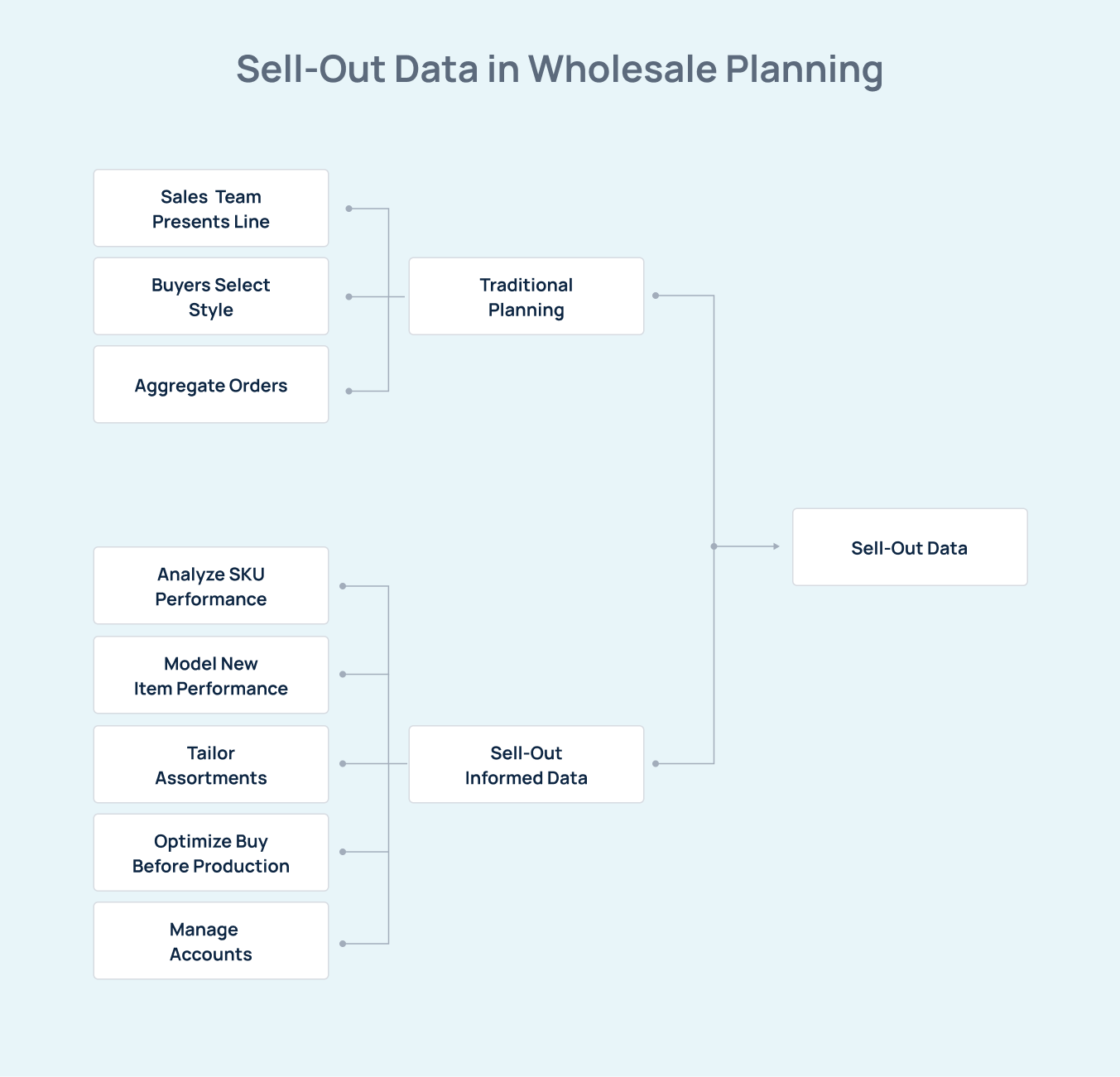
Traditional wholesale assortment planning looks like this:
- Sales team presents the line during market week
- Buyers select styles based on intuition and budget
- You aggregate orders and produce accordingly
Sell-out-informed assortment planning adds another layer:
- You analyze which SKUs performed well at similar accounts
- You model how new items might perform based on comparable sell-through rates
- You recommend assortments tailored to each account's historical performance
- You optimize the buy before production, not after markdowns
This is especially powerful when you're managing hundreds of accounts. A brand selling to 2,500+ wholesale partners can't manually optimize every account's assortment. But with the right data and planning tools, you can surface patterns: which accounts over-buy, which ones could carry more SKUs, and where your assortment is productive versus stagnant.
How to Plan for Wholesale Account Growth Using Sell-Out Data
Sell-out forecasting also helps you plan for account growth more intelligently.
When a wholesale partner expands their store count or opens new locations, you need to decide how much additional inventory to commit. If you only have sell-in data, you're guessing based on past orders. With sell-out data, you can model:
- Current sell-through rate per store
- Projected demand if they add 10 new locations
- Whether their existing assortment should expand or stay focused
This prevents over-committing inventory to growth that doesn't materialize, or under-serving accounts that could scale significantly.
What Modern Planning Tools Should Do at Scale
Managing sell-out forecasting and account-level assortment planning at scale requires more than spreadsheets. Brands working with hundreds or thousands of accounts need platforms that can:
- Integrate POS data from retail partners in different formats
- Cluster accounts by performance, geography, or buyer behavior
- Forecast sell-out using statistical and machine learning models
- Run what-if scenarios to test assortment changes before committing inventory
- Track book-to-sales ratios and fill rates at the account level
- Surface insights like which accounts consistently over-order or under-perform
Platforms like Toolio are built for this. They unify wholesale planning, assortment planning, and allocation in one system, so you're not stitching together data from multiple tools. You can plan by account, by channel, by product, and see how changes in one area ripple through your entire business.
These tools also support multi-plan scenarios, running separate plans for DTC, wholesale, and international, then integrating them to avoid conflicts or overproduction.
Why Sell-Out Forecasting Is the Future of Wholesale Strategy
If you're still planning wholesale based only on sell-in, you're leaving money on the table. You're over-investing in accounts that underperform and under-serving the ones that could grow. You're making assortment decisions without knowing which SKUs actually move.
The future of wholesale planning is:
- Sell-out informed, not just sell-in tracked
- Account-specific, not just channel-level
- Predictive, not just reactive
- Collaborative, with retailers as partners in inventory optimization
This doesn't mean wholesale becomes easy. The relationships still matter. The buyer dynamics are still complex. But when you layer data and planning tools on top of those relationships, you make better calls faster.
Start Integrating Sell-Out Data Into Your Wholesale Planning
You don't need to transform your entire wholesale operation overnight. Start with:
- Request POS data from your top 10 accounts, see what they're willing to share
- Track sell-in vs. sell-out manually in a spreadsheet for one season
- Analyze account performance to identify patterns in sell-through rates
- Test assortment changes with one or two accounts based on their sell-out data
- Evaluate planning tools that support account-level forecasting and scenario modeling
The brands that master sell-out forecasting and account-level planning will have a significant edge. They'll plan tighter, react faster, and build stronger partnerships with their best wholesale accounts.
And in a channel where margin is tight and competition is fierce, that edge matters.
Ready to evolve your wholesale planning beyond sell-in? Toolio helps brands manage account-level bookings, integrate sell-out data, and optimize wholesale assortment decisions. Speak to an expert to see how it works.


