About
The gap between AI excitement and execution is real, and closeable. Here's what separates retailers pulling ahead, why explainability matters, and how the best teams keep up through volatility.
Q2 2026 Edition
In-Stock
The unhedged truth about retail planning.

The gap between AI excitement and execution is real, and closeable. Here's what separates retailers pulling ahead, why explainability matters, and how the best teams keep up through volatility.

This quarter, our support agent handled 70% of all incoming customer questions, faster and more accurately than any human team could at that volume. Customers are having planning conversations with our AI at 2am on a Sunday, getting thoughtful, knowledgeable answers in real time. When a customer request aligns with our product vision, AI agents open pull requests and start building immediately. Our consultants can instantly surface solutions we've already deployed at other accounts, pulling from every customer conversation we've ever had.
It’s gone beyond an AI pilot. This is how we work now.
We got here by asking one question over the holidays: what would it look like if we treated AI agents as team members, not just tools? In Q1, models crossed a threshold where that question became answerable. Agents can now sustain focused work for hours, access organizational knowledge through standardized protocols, and coordinate across complex workflows. We stopped theorizing and started rebuilding how we operate around that reality.
But I want to be direct about something: what we've done internally is still the exception, not the rule.
"The gap between the excitement and the execution is enormous. And that's okay, that's exactly where the industry should be right now."
Most retailers are still trying to understand what this means for them, and that's okay.
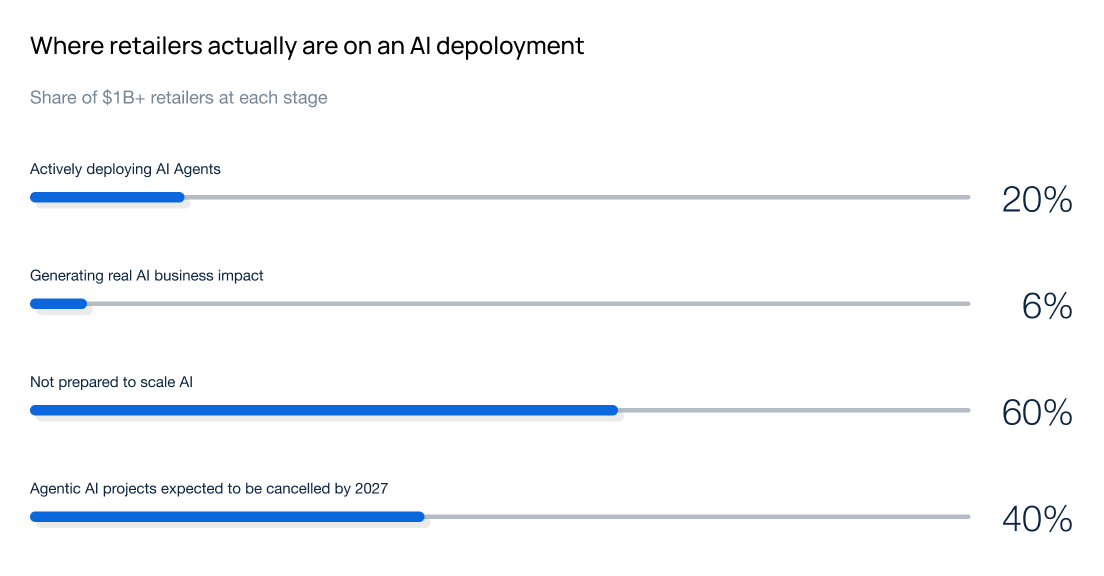
McKinsey found that 61% of merchants say their organizations aren't prepared to scale AI across merchandising. Only 6% of companies globally qualify as AI high performers generating real business impact. Gartner predicts over 40% of agentic AI projects will be canceled by 2027, and most of those failures are predictable. They share the same profile: data quality treated as an afterthought, governance bolted on after the fact, and expectations set by demos rather than deployments.
The companies pulling ahead invested early in the unglamorous stuff. Clean data. Modern architecture. Clear AI governance. The returns are showing up now, retailers using AI are seeing roughly double the sales growth and more than double the profit growth compared to those that aren't.
The trajectory is clear. NRF 2026 made agentic AI the central conversation. Google's CEO made his first-ever appearance at the event to announce the Universal Commerce Protocol alongside Walmart. Every major vendor shipped agent capabilities. Accenture is already reporting 250+ basis point profit improvements from agentic AI in merchandising.
We're watching our own customers start to move. Some are using agents to identify anomalies in store allocations. Others are connecting Toolio data to drive decisions across other systems, using our platform as the intelligence layer for broader workflows. We're piloting MCP servers to enable exactly these use cases, and we'll have more to share soon.
The gap between excitement and execution is real. But it's closeable, and the window for early movers is open right now. We're applying this every day at Toolio, and we're here to help our customers do the same.
More to come.

Here is the paradox that has held AI adoption back for so long: the more powerful the model, the harder it was to interpret. A deep learning model might outperform a planner's intuition by 20 percentage points on forecast accuracy, but if the planner can't understand what's driving it, they won't act on it. They'll override it. They'll ignore it. And all that predictive power goes to waste.
That era is ending. The most consequential shift in retail planning software isn't just the sophistication of what AI can do. It's the fact that planners are starting to understand and trust it. Accuracy without explainability isn't a competitive advantage, it's an expensive black box that gets ignored. Most vendors are still optimizing for the wrong metric.
Modern retail planning is an extraordinarily complex problem. A mid-size retailer might be simultaneously managing thousands of SKUs across dozens of locations, balancing open-to-buy budgets, responding to shifting consumer trends, and trying to avoid the twin disasters of stockouts and excess inventory, all while navigating a supply chain that still hasn't fully recovered from years of disruption. And continues to be disrupted.
No human team, however talented, can optimize all of those variables in real time. AI can help.
Today's planning platforms use machine learning models that ingest years of historical sales data, integrate external demand signals like weather, seasonality, and macroeconomic trends, and generate forecasts that are measurably more accurate than traditional statistical methods. Where a planner using a spreadsheet might apply a flat 5% growth assumption to a category, an AI model is capturing non-linear patterns, identifying emerging winners, and flagging laggards before the monthly review even happens.
The best implementations embed this intelligence natively into planning workflows rather than bolting it on as a separate system. Recommendations surface in context, exceptions get flagged automatically, and forecasts update as new data flows in, all without requiring planners to context-switch into a different tool to understand what the AI is telling them.
Explainable AI (XAI) is the discipline that breaks open the black box. Using techniques like SHAP (Shapley Additive Explanations) and feature attribution modeling, modern planning software can now tell a planner not just what the forecast is, but why. What variables are driving this prediction? What changed from last week? What would happen to the forecast if the promotional plan shifted?
"When a planner can see that a demand spike is being driven by a weather pattern combined with a competitor's stockout signal, they don't just accept the recommendation, they learn from it. The AI becomes a collaborator, not an oracle. Trust compounds over time."
This is beyond a nice-to-have. When a planner can see that a demand spike in women's outerwear is being driven by a weather pattern in the Northeast combined with a competitor's stockout signal, they don't just accept the recommendation, they learn from it. The AI becomes a collaborator, not an oracle. Trust compounds over time.
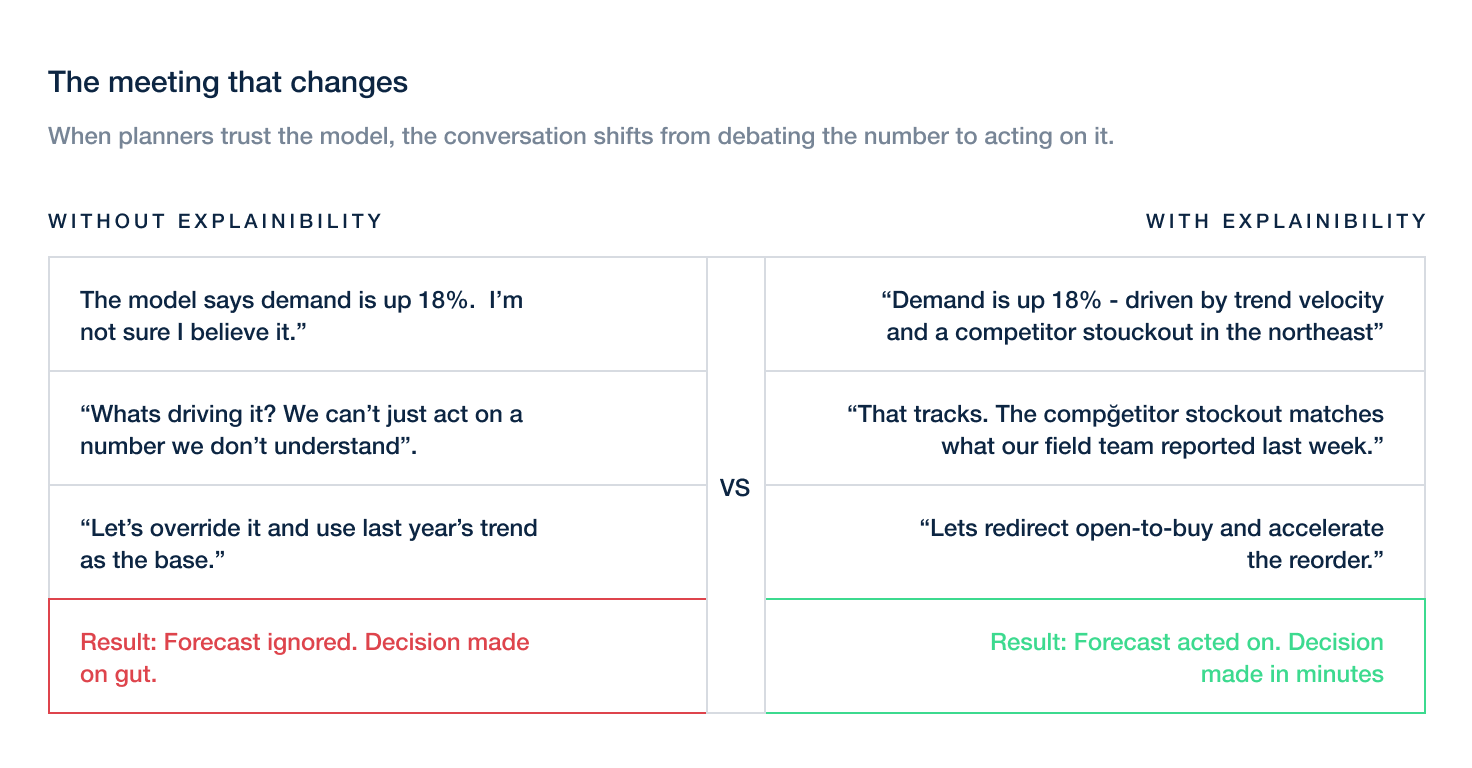
When AI-powered forecasting is paired with explainability, the planning process moves from reactive to anticipatory. Instead of reviewing last month's performance and adjusting, planners can see forward-looking signals, and understand them. An AI that surfaces "this category is projected to outperform plan by 12% over the next six weeks, driven primarily by trend velocity on social channels and repeat purchase rate increases" gives a planner something to act on. They can redirect open-to-buy. They can accelerate reorders. They can adjust the assortment in real time.
Retailers who are embracing explainable AI in their planning processes are not just getting better forecasts. They are making better decisions, faster, with higher organizational alignment. Planners trust the tools they use. Executives trust the plans that come out of them. The feedback loop between machine intelligence and human judgment accelerates.
Those who are still waiting, still skeptical, still operating on gut instinct and static spreadsheets, are falling further behind every quarter. The competitive divide between AI-native retailers and those still catching up is not a gap that will close on its own.
The planning software that wins in this environment treats explainability as a first-class feature, not a tooltip or a footnote, but a built-in capability that lets planners interrogate a forecast, understand what changed, and make decisions with confidence rather than anxiety. The black box is open. The question is whether your team is looking inside.
The conversation among retail planning leaders goes somewhere familiar pretty fast. Tariffs. Lead times. Supplier risk. The words change slightly, but the frustration underneath them is the same.
Planning has always had uncertainty baked into it. But what we're hearing right now feels different. It's not one disruption they're recovering from, it's a constant state of change.

One planning leader told us they have to re-quote products every three months because prices shift so often. Another mentioned that tariff differences between two suppliers can throw off their entire cost model. Even a one percent difference matters when you're working at scale.
The problem is when costs change, it takes days to understand the full impact. By the time the updated plan is ready, something else has already changed.
Orders planned for January showing up in March. And even when lead times are in the system, they're not always right. Someone loads a single blanket estimate across all products, but different categories run on very different timelines. If those differences aren't captured accurately, you're building receipts on bad assumptions from the start.
The teams navigating this best aren't trying to nail a single lead time estimate. They're building in buffers, tracking by supplier, and keeping plans flexible enough to adjust when a shipment slips. But doing that manually is exhausting, and most systems don't make it easy.
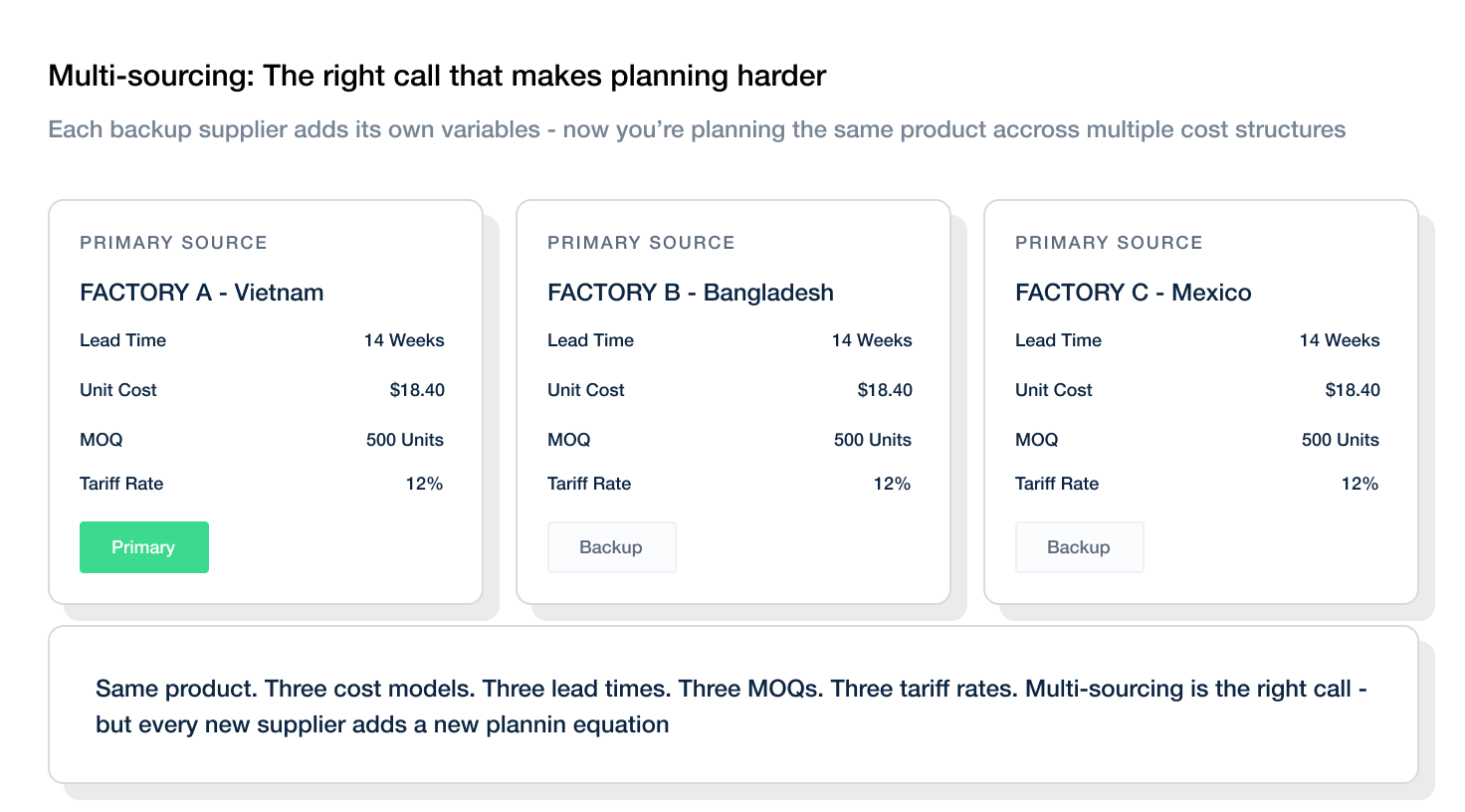
A lot of brands have added backup suppliers over the past year. The reasoning is sound, if one factory goes down or tariffs shift, you want options. But each new supplier brings its own cost structure, lead time, MOQ, and country of origin. Now you're not just planning one product, you're planning the same product across two or three sources, each with different variables.
Cash is tight. Holding excess inventory feels risky. But so does running lean when supply is unpredictable. Teams are caught between those two realities every week.
One planning leader put it well: if they could cut weeks of supply from six to three across the company, it would free up a significant amount of cash. But to do that safely, you need confidence in your numbers, demand read accurately, supply signals reliable. Without that, cutting inventory targets feels like gambling.
"If we could cut weeks of supply from six to three across the company, it would free up a significant amount of cash. But to do that safely, you need confidence in your numbers."
Planning used to be a quarterly or monthly exercise. Now teams are replanning weekly, and leadership expects plans to reflect current reality, not what was true three weeks ago.
The teams feeling the most pressure are the ones where replanning is still a heavy lift. The ones getting ahead aren't better at predicting what's going to happen. They're faster at responding when it does.
Perspectives from consulting and advisory partners working with enterprise retailers every day
Consultants and system integrators sit in an unusual position. They've seen dozens of implementations across hundreds of brands. They know what the pitch left out. They're in the room when things go sideways. They have no reason to oversell.
We asked several of ours what they're actually seeing. Here's what came back.
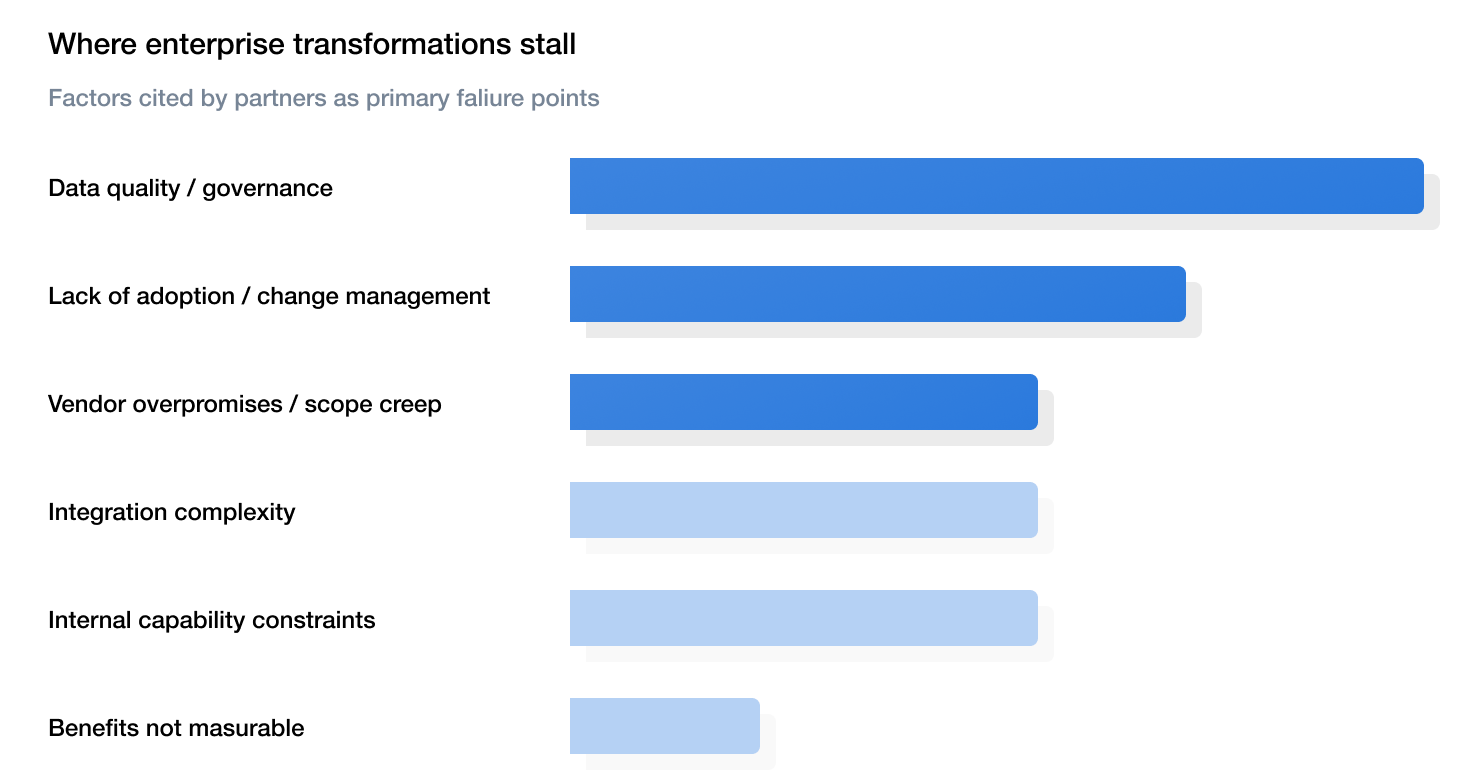
What stalls transformations isn't the software, it's everything around it. Change management. Adoption. Organizational readiness that was assumed rather than built.
Data quality is the other consistent culprit. Retailers go in believing their data is cleaner than it is. That gap surfaces fast once integration starts, and when it does, timelines compress and budgets expand. One partner put it directly: the projects that go well are the ones where data governance was treated as a pre-condition, not a workstream.
Neither issue is new. What's changed is how often both are still being discovered after go-live rather than before it.
"The projects that go well are the ones where data governance was treated as a pre-condition, not a workstream."
The end-to-end platform pitch is the one partners flagged most. Not because the concept is wrong, but because it sets up the wrong starting point. A phased approach that proves value early and expands from there outperforms a big-bang rollout almost every time. But that's harder to sell in a demo.
Fast implementation is the other one. Retailers want speed to value, vendors say they can deliver it, everyone moves forward. The reality is that a realistic, well-managed timeline produces better outcomes than an aggressive one that slips. The most credible partners right now are the ones willing to push back on unrealistic timelines rather than accommodate them.
Agentic AI is the newest entry on this list. There's genuine interest and genuine promise, but what's being shown in evaluations is mostly still demo-stage. Draw a careful line between what's live and what's coming, and make sure your retail clients do the same.
Focused, best-of-breed tools with deep retail domain expertise are consistently outperforming broad platform plays. Narrower scope, faster time to value, higher adoption.
Anchoring every technology decision to a defined business outcome is also pulling ahead. Not "we need a planning system", but "we need to reduce weeks of supply without increasing stockout risk, and here's how we'll know if we did it." When KPIs are defined before the contract is signed, implementation decisions get easier and results are clearer.
The firms doing this well are starting with outcomes, not technology. That sequencing changes everything about how the project runs.
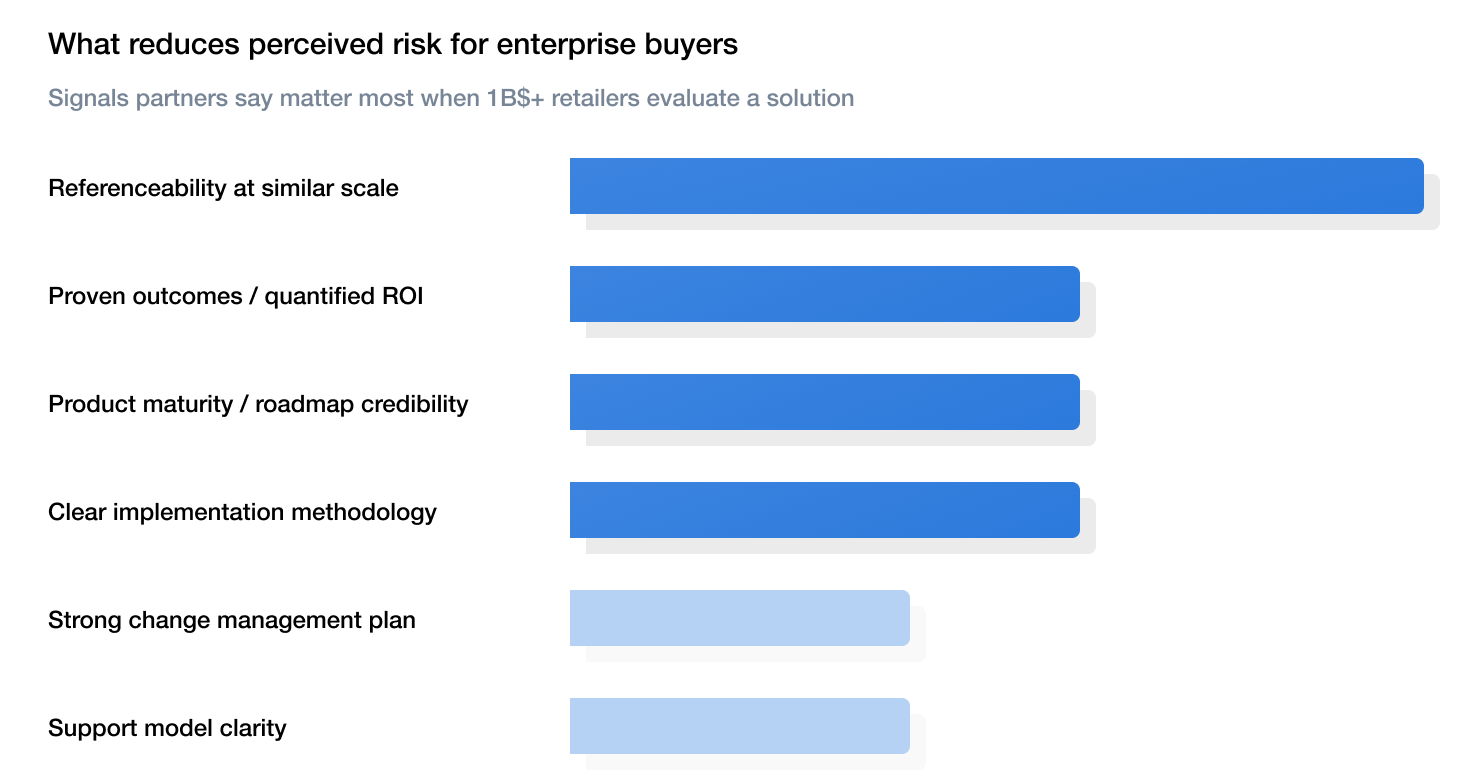
Domain depth. Vendors who can configure software but can't tell you what the process should look like. Retailers want a point of view on best practices, someone to say, "here's how high-performing planning teams run this workflow, and here's how the software supports it." What they usually get is flexible configuration and the expectation they'll figure out the process themselves.
That gap is one of the clearest signals partners use to distinguish implementations that will stick from ones that won't.
Define your requirements and success metrics before you go to market. Not during the evaluation, before it. Retailers who know what they're solving for, specifically and measurably, select better and implement better.
Run a pilot with real data before you commit. Require dedicated business ownership and IT product management from day one. Build or hire a PMO that holds both sides accountable.
The implementations that go well aren't accidents. They have the same structural profile every time.
Past Editions

See Toolio in Action
The best way to understand what Toolio could do for your team is to start a conversation.