











Retail teams are under pressure from every direction. Customer demand shifts quickly. Inventory is expensive. Lead times are inconsistent. And leadership still expects you to protect margin and improve performance.
This is why more retailers are curious about ways to integrate AI to optimize retail supply chains, demand forecasting, and merchandising strategies.
Let’s break down where AI creates real value, what use cases matter most, what types of platforms exist, and how to evaluate them without getting distracted by hype.
If you work in merchandising, supply chain management, or inventory management, this will help you make better technology decisions.
Why AI Is Becoming Essential in Retail Supply Chains
Retail supply chains continue to gain complexity. You’re balancing stores, e-commerce, wholesale, and fulfillment from multiple nodes. At the same time, customer expectations for speed and availability keep rising.
Traditional tools can’t analyze vast amounts of data fast enough. That’s where artificial intelligence AI comes in.
AI powered platforms use machine learning and AI algorithms to:
- Improve demand forecasting
- Optimize inventory management
- Detect risks in supply chain operations
- Respond faster to changes in customer demand
- Support better pricing and assortment decisions
The benefits of AI in retail are measurable. Better forecast accuracy. Lower excess inventory. Higher customer satisfaction. Stronger customer experience. And more confidence in planning decisions.
For many teams, adopting AI-driven planning tools is not about replacing people, but as a force multiplier, supplementing their expertise with data-driven insights.
What AI in Retail Supply Chain and Merchandising Actually Means
When vendors talk about AI systems, it helps to understand what that includes.
In retail supply chains and merchandising, AI typically refers to machine learning models that can:
- Predict future sales based on historical and real time data
- Optimize replenishment and safety stock
- Recommend inventory allocation by location
- Detect anomalies in supply chain operations
- Estimate pricing and markdown impact
Some platforms also include generative AI. Generative AI can summarize reports, answer planning questions in plain language, and help create executive-ready insights.
But the core value still comes from AI algorithms that power demand forecasting, inventory management, and supply chain management decisions.
Where AI Creates the Most Value Across Retail Operations
AI systems can impact every part of retail. But the strongest gains usually happen in planning and execution workflows tied to margin and service.
Merchandise Financial Planning
AI-powered planning platforms help teams connect financial targets to operational decisions.
You can test scenarios quickly using real time data:
- What happens if receipts are reduced?
- How does shifting investment across categories impact margin?
- How does a demand change affect open-to-buy?
This allows planners to respond faster and present data driven recommendations to leadership.
Demand Forecasting and Inventory Management
Demand forecasting is one of the most common AI driven use cases in retail supply chains.
Machine learning models evaluate:
- Historical sales
- Promotions
- Channel mix
- Seasonality
- Store clusters
- External signals
They produce more accurate forecasts and smarter inventory management recommendations.
Improved demand forecasting directly supports better customer satisfaction because products are available when and where customers expect them.
Allocation and Replenishment
Allocation and replenishment connect planning to supply chain operations.
AI-powered systems can:
- Predict store-level demand
- Optimize allocation rules
- Recommend replenishment timing
- Reduce imbalance across locations
Small improvements here can significantly improve sell-through and reduce stockouts, which strengthens customer experience and customer service performance.
Pricing, Markdown, and Promotion Optimization
Pricing decisions influence both margin and customer demand.
AI driven tools can estimate how price changes affect demand. They help merchants determine when to mark down, how deep to discount, and how to protect margin while clearing inventory.
This improves both profitability and customer satisfaction by aligning pricing with actual buying behavior.
Assortment and Category Strategy
Retailers often carry more SKUs than needed. AI systems help analyze vast amounts of data to identify which products truly drive performance.
You can use AI algorithms to:
- Refine assortments by store cluster
- Identify underperforming SKUs
- Support category growth decisions
- Localize assortments
This results in more focused assortments and a stronger customer experience.
Supplier and Lead Time Management
Supply chain management now requires constant monitoring of supplier performance.
AI driven systems can detect patterns in lead times, flag risk earlier, and recommend mitigation strategies.
This improves supply chain operations and reduces the risk of late receipts that impact in-stock rates and customer satisfaction.
Omnichannel Fulfillment Optimization
Modern retail supply chains must balance inventory across stores and e-commerce.
AI powered tools help decide:
- Where to position inventory
- How to allocate between channels
- When to fulfill from store vs distribution center
- How to minimize fulfillment costs
Optimizing these decisions supports stronger customer service and a consistent customer experience across channels.
The Most Common AI Use Cases Retailers Are Investing In
Retailers typically adopt AI systems to solve clear pain points.
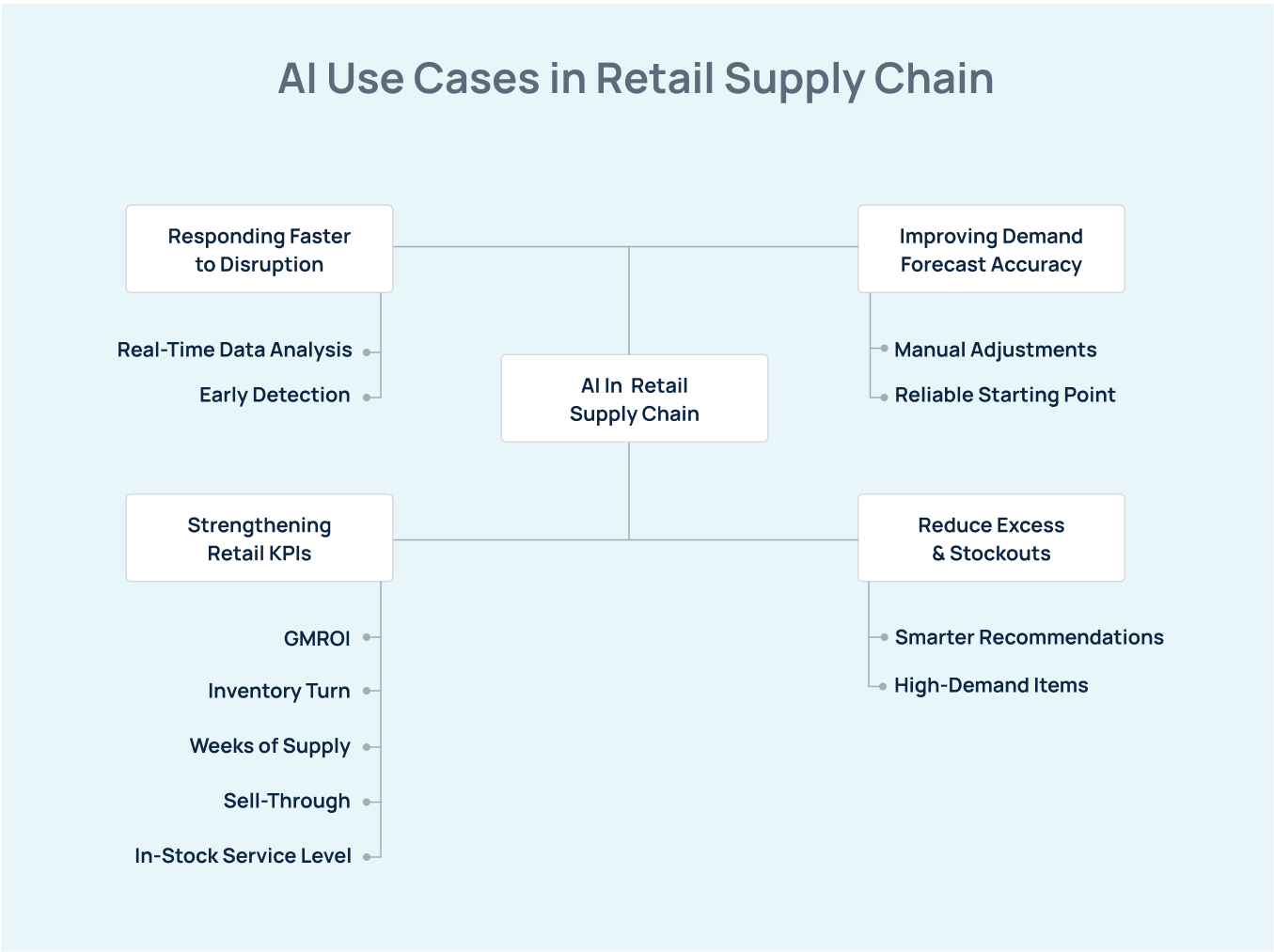
Improving Demand Forecasting Accuracy
Planning teams often adjust forecasts manually. AI algorithms reduce that effort by producing a more reliable starting point.
Better demand forecasting supports better buying decisions and fewer surprises.
Reducing Excess and Stockouts
Inventory management is a major lever for profitability.
AI driven systems recommend smarter inventory levels. This reduces overbuying while keeping high-demand items in stock.
Strengthening Key Retail KPIs
Retailers measure performance through:
- GMROI
- Inventory turns
- Weeks of supply
- Sell-through
- In-stock service level
AI powered planning improves these metrics by connecting demand forecasting, supply chain operations, and financial targets.
Responding Faster to Disruption
AI systems continuously analyze real time data. That allows teams to detect shifts in customer demand or supplier performance earlier.
Faster response improves resilience across retail supply chains.
Generative AI in Retail Planning: Practical Value
Generative AI is gaining attention across retail.
It can help by:
- Answering planning questions in natural language
- Summarizing large reports
- Generating insights for executive presentations
- Supporting onboarding for new planners
But generative AI does not replace core machine learning models. It depends on accurate data and strong planning logic underneath.
When combined with predictive AI algorithms, generative AI can make complex supply chain management data more accessible.
Agentic AI in Retail Planning
Agentic AI is the next step beyond predictive and generative AI. Instead of just producing forecasts or recommendations, agentic AI can take action on its own to achieve a goal you set, like reducing stockouts or improving inventory efficiency.
In retail supply chain optimization, agentic AI can continuously monitor real-time data across sales, inventory, lead times, and fulfillment performance. Then it can automatically trigger actions such as adjusting replenishment plans, recommending inventory transfers, or flagging supply risks before they become major problems.
The key benefit is speed. Agentic AI helps retailers respond to demand changes and supply disruptions faster, without requiring planners to manually review every exception. It turns supply chain management into a more proactive, always-on process.
What Makes an AI Powered Retail Platform Effective
When evaluating AI powered platforms for retail supply chains, focus on impact, not buzzwords.
Retail-Specific Intelligence
The system must understand retail hierarchies, seasonality, and product lifecycles. Generic AI systems struggle without retail-specific context.
Scenario Planning
AI driven platforms should allow you to model scenarios easily. That includes testing changes to buys, pricing, or inventory targets and seeing the financial impact immediately.
Integration with Existing Systems
AI systems must integrate with ERP, POS, OMS, WMS, and e-commerce platforms. Without integration, real time data flow breaks and adoption suffers.
Explainability
Planning teams need to understand why a forecast changed or why a recommendation was made. Transparent AI algorithms build trust.
Speed to Value
Retailers benefit most when implementation supports real workflows quickly and improves measurable outcomes early.
Categories of AI Platforms in Retail
Retailers often use a mix of AI driven tools.
AI Powered Merchandise Planning Platforms
These platforms focus on demand forecasting, inventory management, and financial planning.
For example, Toolio supports merchandise planning workflows that connect strategy to execution using machine learning and real time data. It helps planners improve forecast accuracy, optimize inventory, and respond faster to change.
AI Driven Supply Chain Operations Platforms
These focus on transportation, network optimization, and broader supply chain operations. They help manage logistics complexity across retail supply chains.
AI Demand Forecasting and Inventory Optimization Tools
These platforms specialize in statistical models that support replenishment and inventory management at scale.
AI Pricing and Promotion Platforms
These tools estimate price elasticity and support markdown optimization to protect margin while meeting customer demand.
Retail Data and Decision Platforms
These systems help analyze vast amounts of data across departments and provide predictive insights. They often complement planning tools rather than replace them.
How to Evaluate AI Platforms for Retail
If you are researching AI systems for supply chain management and merchandising, focus on practical outcomes.
Key Questions
- How does this platform improve demand forecasting accuracy?
- How does it support inventory management decisions?
- What supply chain operations workflows are included?
- How does it handle new products without history?
- What measurable benefits of AI in retail have customers achieved?
- How quickly can we implement it?
- How does it integrate with our current systems?
Red Flags
- Heavy use of “AI” language without clear workflows
- No visibility into how AI algorithms work
- Dashboard-heavy tools with limited decision support
- Long implementation timelines with unclear ROI
Metrics to Track
To measure impact, track:
- Forecast accuracy
- Inventory turns
- Weeks of supply
- GMROI
- Service level
- Stockout rate
- Gross margin
These metrics connect AI driven decisions to financial and operational outcomes.
The Best AI Platforms Improve Speed & Decisions
The best AI platforms for retail supply chains and merchandising do one thing well: they improve the speed and quality of decisions.
AI as a whole is powerful for brands and retailers. But it only matters if they help you manage customer demand, strengthen supply chain operations, improve customer satisfaction, and deliver a better customer experience.
When AI-powered systems support real planning workflows, they help you move from reactive problem solving to proactive strategy. That’s where the real value shows up for both you and your business.
Toolio is built for exactly this, using AI-driven planning and optimization to help retailers connect supply chain and merchandising strategies, respond faster to demand shifts, and see what actions will drive the best outcomes for their business. Learn more about Toolio AI.


